

Brewing an ESB From Grain to Glass: A Big All-Grain Brew Day
Brewing an ESB From Grain to Glass: A Big All-Grain Brew Day
Brewing an ESB from grain to glass sounds fairly straightforward. Malt, hops, yeast, water, beer.
Naturally, I decided to make it slightly more complicated.
This brew day involved more than 16 kg of grain, a Guten 70L pushed very close to its limits, a separate Caraaroma mash, several split batches, no-chill brewing, pure oxygen, an early dry hop and one small technical issue where I sealed the fermenter before remembering to add the yeast.
Perfectly normal homebrewing, then.
The result was an Extra Special Bitter at around 6% ABV, with caramel, toffee, spicy East Kent Goldings character, good carbonation and a head that simply refused to disappear.
Was all that effort worth it?
Let’s kick it!
Watch the Full ESB Brew Day
Prefer watching the chaos rather than reading about it?
I’ve brewed up an epic new video for you.
The complete brew day takes this ESB all the way from grain to glass, including the oversized mash, no-chill process, fermentation and final tasting.
Brewing an ESB From Grain to Glass | Full All-Grain Brew Day
ESB Brew at a Glance
Style: Extra Special Bitter
Original Gravity: 1.057
Final Gravity: 1.011
ABV: approximately 6%
Grain: Pale Ale Malt / Golden Promise, Wheat, Caramunich I, Caraaroma
Hops: East Kent Goldings and Target
Dry hop: 50 g / 1.8 oz East Kent Goldings at yeast pitch
Yeast: Angel Yeast CY115 British Ale Yeast
Method: All-grain, no-chill
Fermentation temperature: around 24°C / 75°F
The actual brew day was considerably bigger and more complicated than the recipe most people would want to reproduce at home.
So I’ve also simplified this into a much more sensible 5-gallon ESB recipe, which you can download further down the page.
The ESB Grain Bill
This was partly a clean-out-the-brewery beer.
I had several bags of pale ale malt hanging around, along with Caramunich I and Caraaroma.
Instead of behaving sensibly and simplifying things, I decided to build an ESB around what I had.
The grain bill worked out at approximately:
- 93% Pale Ale Malt
- 3% Wheat Malt
- 2% Caramunich I
- 2% Caraaroma
Of the pale ale malt, roughly 40% was a generic pale ale malt and around 60% was Golden Promise.
The wheat was mainly there for head retention.
And judging by the finished beer, that part worked beautifully.
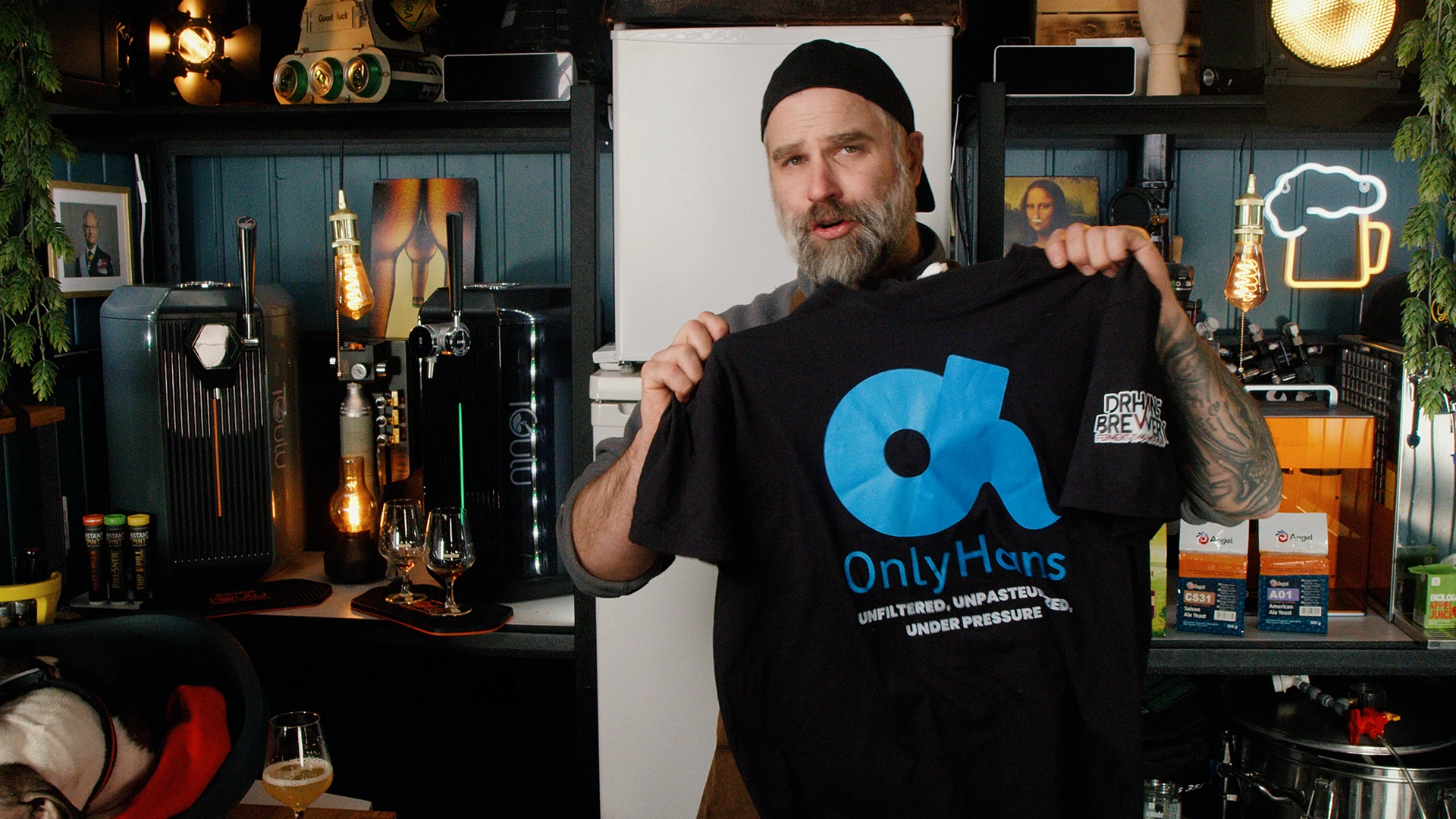
Everyone loves good head (by the t-shirt)
I’m less convinced that the combination of Caramunich I and Caraaroma was absolutely perfect for the beer I wanted, but we’ll get back to that when we taste it.

Maxing Out the Guten 70L
The brewing system may say 70 liters on the label.
In my experience, it is considerably happier around 65 liters / 17.2 US gallons.
For this brew I used somewhere around 16.7 kg / 36.8 lb of grain.
That is a lot of grain for this machine.
The vessel was full.
Very full.
Uncomfortably full.
For a brief moment, I was actually pleased that a small amount of pale ale malt had been left unused.
I told myself that next time I would use less grain.
I have made similar promises before.
The mash ran for roughly an hour. I started fairly low and ramped the temperature while continuously circulating wort through the grain bed.
Once the mash was complete, I lifted the grain basket and sparged until the main vessel reached around 65 liters.
And yes, wet grain is considerably heavier than dry grain.
I somehow rediscover this every time.

Why I Mashed the Caraaroma Separately
This wort had more than one destiny.
I wanted to pull off several portions of strong base wort for other experiments, so I didn’t want all of the specialty malt character from the ESB ending up in every batch.
The Caraaroma was therefore crushed and mashed separately.
I took hot liquor directly from the main mash, which also brought some active enzymes with it, mixed it with the Caraaroma and placed the smaller mash somewhere warm to hold temperature.
Once it had done its job, I separated the grain using extremely specialized brewing equipment.
A kitchen strainer.
The Caraaroma wort was then reduced separately and kept aside until I had removed the portions of strong base wort for the other beers.
It sounds slightly ridiculous.
It worked.

One Big Wort, Several Beers
This wasn’t simply one giant batch of ESB.
During the brew, I removed three portions of approximately 8 liters / 2.1 US gallons of strong wort.
Those will eventually become three different IPAs.
More experiments are coming.
The wort remaining in the Guten was still stronger than I wanted for the ESB, so I diluted it before adding the separately prepared Caraaroma wort.
I was aiming for an original gravity of around 1.055.
I got:
1.057
Close enough.
The Caraaroma wort then went back in, giving the ESB additional caramel character, color and darker malt character without affecting all of the other beers built from the same base wort.
East Kent Goldings, Target and No-Chill Brewing
For the hops I used East Kent Goldings and Target.
Because I brew using the no-chill method, I handle late hop additions differently than I would if I were rapidly chilling the wort.
The hops went into the hop spider at flameout and I stirred while the temperature began to fall.
When calculating bitterness for my no-chill process, I generally treat that type of addition roughly as if it had received around a 20-minute boil.
That approach has worked consistently for me.
Once everything was done, the system was covered and the wort was allowed to cool naturally overnight.
If you want a deeper look at how I handle no-chill brewing, I made a full guide here:
No Chill Brewing Method Guide – From Zero to Brew Hero


CY115 British Ale Yeast, Oxygen and Yeast Nutrient
The following morning, the cooled wort went into the Kegmenter.
Before pitching the yeast, I oxygenated the wort using pure oxygen through a diffusion stone.
During the boil I had also added BrewNutri-Z yeast nutrient.
For the ESB I used Angel Yeast CY115 British Ale Yeast.
Then I sealed the fermenter.
Very professional.
There was just one small issue.
I had forgotten to put the yeast in.
Fortunately, I noticed fairly quickly.
CY115 finally went into the wort and fermentation could actually begin.
The beer started fermentation at around 24°C / 75°F.
A Quick Shoutout to Angel Yeast
A quick shoutout to Angel Yeast, who sponsored the video this article is based on and supplied the CY115 British Ale Yeast used in the brew.
If you want to check out Angel Yeast and their brewing yeast range, you can find them here:


Dry Hopping at Yeast Pitch
I also added 50 g / 1.8 oz of East Kent Goldings immediately at yeast pitch.
Yes, before fermentation.
I’ve previously compared dry hopping before fermentation with dry hopping later in the process.
One of the biggest differences in that particular experiment was that the early dry-hopped beer showed slightly more bitterness.
That doesn’t mean early dry hopping is automatically better.
One experiment is still just one experiment.
Good data usually requires doing the stupid thing again.
If you want to see that comparison:
Dry Hopping Experiment: Before vs After Fermentation
OG, FG and ABV
The finished beer landed at:
Original Gravity: 1.057
Final Gravity: 1.011
Alcohol: approximately 6% ABV
The final gravity was a little lower than I originally expected.
CY115 kept eating.
Between the relatively fermentable wort, mash profile, yeast nutrient and pure oxygen, I had given the yeast pretty much everything it could ask for.
The result was a slightly drier beer than planned.
At around 6% ABV, however, it drinks surprisingly easily.
Which is both a compliment and a warning.

So, How Did the ESB Taste?
Now for the important part.
The beer pours with a beautiful and persistent head.
The wheat definitely earned its place in the recipe.
On the nose, I get some spice from the East Kent Goldings together with a clear caramel character.
In the flavor there is caramel and toffee, but I don’t really pick up any obvious diacetyl.
The fermentation comes across as very clean.
Carbonation is good.
The beer is drier than originally planned, but that also makes it surprisingly easy to drink for something sitting around 6% ABV.
It doesn’t really drink like a 6% beer.
Again — compliment and warning.
At tasting, the beer was also at around 3°C / 37°F, so some of the malt character became even more expressive as it warms in the glass.

What Would I Change Next Time?
I like this beer, but I wouldn’t brew it exactly the same way again.
The biggest question for me is the caramel malt.
Could I have used more?
Maybe.
Did I choose exactly the right caramel malts for the beer I wanted?
I don’t think so.
If I brewed this again as a dedicated ESB rather than pulling it out of a much larger split-batch brew day, I would probably rethink the specialty malt combination.
I might also push the hop character slightly further.
And yes, somebody will inevitably tell me that I should have dry hopped after fermentation instead.
Maybe.
The wheat, however, stays.
Look at that head.
I’d also think twice before putting 16.7 kg of grain into the Guten 70L again.
Think twice.
Then probably do it anyway.
I do these experiments so you don’t have to.
Brew This ESB at Home
The actual brew day in the video was built around a much larger batch and several other beers, so it isn’t exactly the sort of recipe most homebrewers would want to reproduce as-is.
So I simplified it.
I’ve turned the beer into a practical 5-gallon ESB recipe that you can actually brew on a normal homebrew setup.
You can download the 5-gallon recipe PDF here:
https://buymeacoffee.com/drhans/e/582090
Brew Crew Extras
For my Patreon Brew Crew supporters, I also provide the usual recipe extras, including the BeerXML file along with the recipe PDF.
That means you can import the recipe directly into compatible brewing software, adjust it for your own system and start tweaking it from there.
If you want the recipe files and want to support more experiments like this one, you can join the Brew Crew here:
More recipes, more experiments and probably more questionable decisions involving oversized grain bills.
Sounds about right.
DrHans Out!
More Brewing Experiments
If you enjoyed the process behind this beer, these videos tie directly into some of the brewing choices I made:
Is Over Sparging Really a Problem? – ExBEERiment
Dry Hopping Experiment: Before vs After Fermentation
No Chill Brewing Method Guide – From Zero to Brew Hero
And of course, you can watch the complete ESB grain-to-glass video here:
Brewing an ESB From Grain to Glass | Full All-Grain Brew Day
Social Media and Contact Information:
Instagram: @drhansbrewery
Facebook: @drhansbrewery
Webpage: https://drhansbrewery.com
Contact Email: drhansbrewery@gmail.com
Support and Merchandise Links:
🔥 Get 20% Off iGulu Gear (Code: DRHAN20) 👉 https://igulu.com/?sca_ref=6679834.Gm6UfWKv2R
- 📚 Learn the art of homebrewing alongside me: https://solo.to/drhansbrewery
- 🛒 Check out the gear that elevates my brewing and video game on Amazon: http://bit.ly/drhanssf
- 📘 Grab your FREE brewing ebook on my website: http://bit.ly/DrHans
- 💰 Loved the blog? Buy me a virtual beer! https://bit.ly/ByMEaBEER 🍻 Cheers!
- Support my content on Patreon from just $2/month: https://bit.ly/2V5Zsgz
- 💼 Become a channel member for access to exclusive content: https://bit.ly/3fVQav7
- 🙏 Donate to DrHans via PayPal: https://bit.ly/DonateDrHans
- 👕 Check out my exclusive merch! Unique items await at my shop: https://bit.ly/DrHans-Merch

Recent Comments